
ATMPs: At the Precipice of Success or Failure
With major therapeutic indications close on the horizon, the industry must urgently address the prohibitive costs and manufacturing complexities currently blocking patient access to life-changing cures.
Stream on your favourite platforms.
Advanced therapy medicinal products (ATMPs) are groundbreaking, innovative treatments for many patients once considered untreatable. However, while enthusiasm for the therapeutic promise these therapies hold is swelling, the bio/pharma industry needs to overcome various obstacles to ensure future success of the field is possible and that patients gain access to the potentially curative solutions they need.
Click above to listen to the full conversation from Terrapinn’s Advanced Therapies Congress 2026 in the latest episode of All Points of the Pharma Compass or read on for more…
A Tough Investment Landscape
“The overall global investment environment has been very tough of late, which has, consequently, trickled down to the bio/pharma industry,” says Miguel Forte, ISCT President, ARM board member, and CEO, Kiji Therapeutics. While bio/pharma is a highly promising industry, it is also considered to be risky, particularly earlier on when companies are just starting out, which is difficult from an investment perspective, he adds.
Investors have walked away from potential prospects recently and early-stage venture capital investment is also proving difficult, leading companies to find potential alternatives for funding, Forte notes. “What I think is happening is when a company is created, before evidence has been generated, that's really where the risk is highest — the promise is significant, but there's very high risk there as well,” he continues. “In the current environment, I think people walk away from that risk and wait to see more proof of concept, supported technologies that then will allow them to invest with more security.”
As a result, companies are now seeking out alternative ways to gain funding early on, Forte remarks. However, while it is imperative for companies to gain funding early on, it is also important for them to consider how they can optimize their value proposition and to ascertain whether the proposition will be successful when it goes to market, he specifies.
“So, when a project is started, it is important to have the end in mind,” Forte reveals. “That mindset will not only help the whole value chain, but it will also convince the investor that the project is the right value proposition, and can be handled accordingly, so it will be possible to have a return on investment and treat patients.”
Stuart Curbishley, Chief Manufacturing and Development Officer, adthera bio, concurs that even early on, investors now expect there to be relevant data available that will support their investments and reduce the potential risk. “So, I think for those early investments, we need a different way of funding that process to give the investors a de-risked pot to invest in,” he says.
Using the high cost of chemistry, manufacturing, and controls (CMC) as an example, Curbishley notes that investors now want a strategy that’s defendable and scalable from the start, rather than something that may be fixed in time. What this means is that companies need to consider costs — of goods, of manufacturing — and formulate a plan to reduce these down to something that is meaningful for investors, he asserts.
“Thinking about the treatments that are being offered today, they’re relatively scarce and in small numbers,” Curbishley continues. “The moment there is a solution for a ‘big ticket’ solid tumor, even the U.S. payer system can’t cope with it, so, how can these therapies get to the masses?”
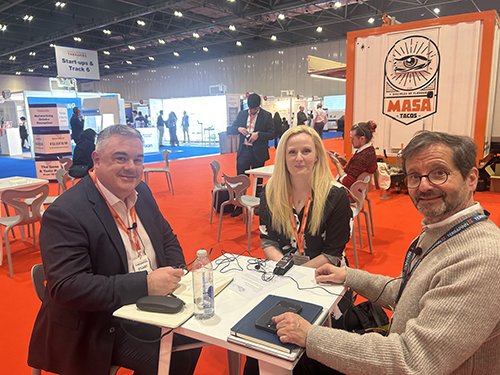
(From left to right) Stuart Curbishley, Felicity Thomas, and Miguel Forte, pictured at Terrapinn’s Advanced Therapies Congress 2026 in London, UK, by Neil Hunter.
[Photo used with permission from Neil.]
Overcoming Manufacturing Costs
Next-generation technologies are certainly helping to improve manufacturing cost efficiency; however, there is a need for the industry stop delaying the implementation of potential solutions until a later date, Curbishley stresses. Scalable platform manufacturing is a prime example of where companies can potentially reduce costs, but companies believe they can implement such a solution later on, he remarks.
“I think, in fact, that platform approaches should be implemented as soon as possible,” Curbishley continues. “Also, platform developers need to have solutions that are more scalable.”
It is not cost-effective to put an extremely expensive device into a facility for a first-in-human project, Curbishley asserts. However, if it is possible to have a scaled version of that device, which can then be fitted into an automation solution over time, then that would provide viable, cost-efficiency for the manufacture of ATMPs, he adds.
Additionally, as more devices are used and connected to one another the complexity of the manufacturing process increases, if some of those connections are removed and some of the activities are consolidated onto fewer devices, the manufacturing process can be simplified and costs will be driven down, Curbishley confirms. “This process simplification also means that it would be possible to transfer everything over to different facilities more readily,” he adds.
Curbishley hopes that industry can get to a point where ATMP manufacturing is more ‘plug and play’, similar to vaccine manufacturing. “The process isn’t reapproved for every new batch of vaccine, the appropriate target is just dropped in,” he says. “So, is it possible to get to a position where there is an agreement on a licensed process and manufacturers can just drop in what is needed with the therapy and development?”
There has been some regulatory development within this area, Forte notes, pointing to the FDA’s Plausible Mechanism Framework (1). “It is interesting to see that as the maturity of the ATMP field grows, the complexity increases, but really with maturity, complexity should reduce,” he states.
“Normally, when a certain stage of maturity is reached, regulations and manufacturing are de-complexified,” Forte continues. “For ATMPs, there is still a need to address the ‘de-complexifying’ in the clinic and for the launch.”
A Regulatory Balancing Act
There has been some good spoken intention with regards to the regulatory landscape for ATMPs, but this intention has not necessarily transferred over into practice, Forte specifies. “There’s hope, nevertheless, because after all, the intention is there and comes from the fact that we know a lot more about ATMPs and are a lot more comfortable and can inform our risk–benefit better,” he says.
The ability to inform the risk–benefit, which is not a fixed target and can be dependent upon various factors — the individual patient, the size of the patient population, the unmet need, the technology being assessed, and so forth — is critical for regulations, Forte asserts. There has been an evolution and maturity in the regulatory bodies’ approaches towards ATMPs, and they are now more reactive to the evolving field, they recognize the growing knowledge of the field, and are becoming more aligned with each other as a result, he adds.
However, while there is formal harmonization in terms of the ICH, there is also need for practical learning in how to be aligned on regulations, Forte explains. “At every ISCT annual meeting, there is a global regulatory forum where regulators are brought together in a closed session so they can learn with others from around the world,” he says.
Echoing Forte’s sentiments, Curbishley added that while it is understandably necessary to build a process in order to achieve a consistent product, it is also necessary to understand the problem better and allow the process to adapt accordingly. For example, if there is a manufacturing change, such as the implementation of a new bioreactor, then the regulators will deem that the resulting product will change too, which is not necessarily true but cannot be proven with data.
“There is a need to get to a point of harmonization in time, but there also needs to be a period of flux where industry decides on what to actually harmonize,” Curbishley says. “At the moment, there isn’t an agreement on what the right manufacturing route is for ATMPs. So, it is important to maintain flexibility and make sure harmonization happens when it is clear everything is right.”
Next Steps to Ensure Success
While there are some technological barriers to overcome for future ATMP success, work is being done in this area and there have already been improvements, Forte notes. Another critical point that needs to be addressed for the future of ATMPs is the perception of the business model and the value proposition, he asserts.
“The value proposition is very challenging because, currently, there are multiple aspects to it,” Forte continues. “There are a lot of shadows falling over the biotech sector, particularly for complex things like cell and gene therapies. What also needs to be understood is that the world is a troubled one and is impacting us significantly. So, we need to have to be resilient, nearly stubborn, have a good sense of humor, and really have the passion for what we do.”
For Curbishley, the sector is facing a ‘crunch point’ in terms of costs and is something that needs to be urgently addressed. “We have to fix the cost issue because the big indications, autoimmune, solid tumor, are just around the corner and if there isn’t any change to cost then the industry just won’t succeed,” he warns. “The changes over the next five years will be critical to seeing ATMPs exist in the next 50 years.”
The means to make these changes already exist within the industry, it’s just the right people need to come together and have the relevant conversations to figure out how to get the costs down, Curbishley adds. “The tools are already there, we can fix this issue,” he specifies. “In five years, I hope that we’ll be looking back, remembering when we were at this precipice and saying, ‘look at where we are today’. The promise is there.”
Reference
1. FDA. FDA Launches Framework for Accelerating Development of Individualized Therapies for Ultra-Rare Diseases. Press Release, Feb. 23, 2026.
Music from #Uppbeat (free for Creators!):
https://uppbeat.io/t/roo-walker/over-the-horizon
License code: JDOYSHIQBT8JRFSV
Image Credit: © Dilok - stock.adobe.com