
BIO 2026: Building Supply Ahead of Demand
Ahead of BIO 2026, FUJIFILM Biotechnologies’ Toshi Iida outlines why the industry must pivot toward harmonized, modular facility networks to eliminate manufacturing bottlenecks and secure the global medicine supply.
“The demand for bio/pharmaceuticals is growing rapidly and is expected to continue to grow about 9% every year,” notes Toshi Iida, Board Director, FUJIFILM Corporation; GM, Life Science Strategy Office; Chairman, FUJIFILM Biotechnologies Group. This growth is being driven by various key factors, including the increasingly aging population, related rising prevalence of chronic disease, and continuous innovation in new pipelines to meet unmet medical needs, he reveals.
However, while many innovators are investing resources into novel pipelines, there is a growing trend to source out manufacturing to service providers, particularly for the larger-scale projects, Iida adds. This trend is demonstrated by the fact that the market growth for outsourcing is outpacing that for the bio/pharma market, he specifies. Even in combination, capacity from both bio/pharmas and CDMOs will not be sufficient to meet market demand, Iida asserts.
AI-enabled drug discovery is further contributing to market growth as early-stage drug discovery is broadening and more candidates are being progressed into the clinic at a quicker rate, Iida confirms. “Long lead times and a heavy capex requirement means that supply must be built ahead of demand,” he says. “Manufacturing cannot be allowed to be the bottleneck for companies.”
To address these compounding bottlenecks and protect the critical continuity of medicines, the sector requires a massive injection of capital, sophisticated process development, and resilient raw materials supply, Iida stresses. This long-term supply gap is precisely why FUJIFILM has strategically invested over USD 10 billion US dollars into its global life sciences organization over the past decade, focusing primarily on manufacturing infrastructure to meet upcoming sponsor needs, he explains.
A cornerstone of this infrastructure deployment is a shift away from traditional pharmaceutical manufacturing layouts, which have historically relied on isolated, bespoke plants to ship products from a single source to everywhere in the world, Iida notes. Instead, the modern industry is pivoting toward an interconnected framework governed by standardized, modular operating architectures across international borders.
FUJIFILM utilizes its own specific KojoX operating system to anchor its global network of modular facilities, which directly alters the predictability of tech transfers, Iida explains. “KojoX is a standardized operating system for bio manufacturing across our network that delivers speed, scalability, and resilience without sacrificing quality,” he says. By using functionally equivalent and highly configurable nodes across the network, underlying architectures remain harmonized, meaning regulatory work becomes simpler and programs can move swiftly, Iida specifies.
This predictable operational scaling underpins the broader industry trend of sponsors seeking comprehensive, end-to-end service partnerships that stretch seamlessly from initial drug discovery to commercial manufacturing. “Strategic partnerships with organizations that can provide end-to-end life science solutions from discovery to the commercial supply are beneficial for complex, high-risk, or long-term activities where knowledge sharing, scalability, and the regulatory alignment are critical,” Iida summarizes.
FUJIFILM Biotechnologies will be exhibiting at this year’s BIO conference at stand #3123.
Click the video above to view the full interview
About the Speaker
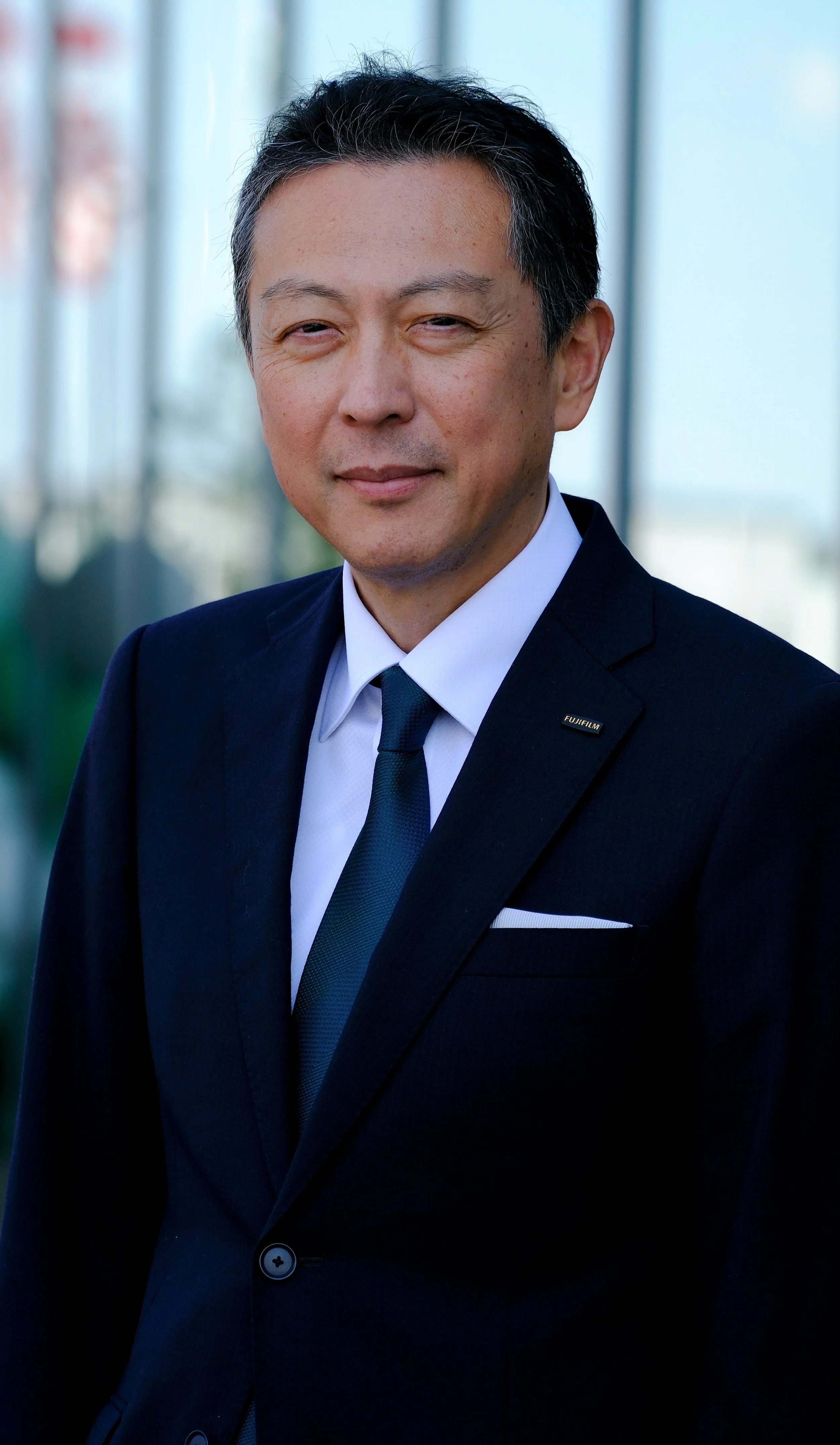
Toshihisa ‘Toshi’ Iida is Board Director, FUJIFILM Corporation; GM, Life Science Strategy Office; Chairman, FUJIFILM Biotechnologies Group. Toshi has been part of FUJIFILM Corporation for over three decades. Throughout his remarkable journey since joining Fuji Photo Film in 1991, Toshi has successfully held key leadership roles in Japan, Europe, and the United States.
In June 2024, Toshi was appointed to the Board of Directors for FUJIFILM Corporation as Vice President, General Manager of the Life Science Strategy Headquarters and Bio CDMO Division, in addition to his role of Chairman for FUJIFILM Biotechnologies. In April 2026, Toshi’s role was expanded to include responsibilities for the entire life science division, as well as the pharmaceutical and CRO divisions, Toyama Chemical and the Cell Therapy business.
Prior to his current roles, Toshi served as President and CEO of FUJIFILM Europe GmbH based in Dusseldorf, Germany, and FUJIFILM Europe B.V., with headquarters in Tilburg in the Netherlands. Toshi received his degree from Keio University in Tokyo, Japan in 1991.
Music from #Uppbeat (free for Creators!):
https://uppbeat.io/t/richard-smithson/air
License code: 6VTV63EGHQK9EBVH
Image Credit: © royyimzy - stock.adobe.com